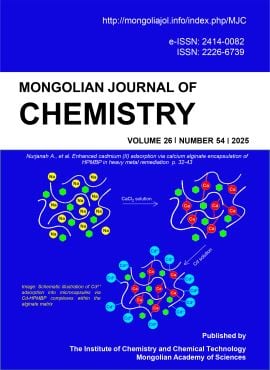
Enhanced cadmium (II) adsorption via calcium alginate encapsulation of HPMBP in heavy metal remediation
DOI:
https://doi.org/10.5564/mjc.v26i54.3869Keywords:
Adsorption, calcium alginate, 1-phenyl-3-methyl-4-benzoyl-5-pyrazolone, encapsulation, microcapsulesAbstract
Heavy metal contamination from industrial activities poses serious environmental and health risks, particularly from cadmium (Cd), and the removal through adsorption using calcium alginate encapsulated with 1-phenyl-3-methyl-4-benzoyl-5-pyrazolone (HPMBP) offers a promising solution. This study aims to improve Cd(II) ion adsorption by encapsulating HPMBP in calcium alginate beads and assess its effectiveness in contaminated water remediation. HPMBP was synthesized and encapsulated in calcium alginate beads to produce Ca-alginate-HPMBP microcapsules, characterized using FTIR), proton nuclear magnetic resonance (1H NMR), and Scanning Electron Microscopy (SEM) analysis. Adsorption experiments evaluated pH, contact time, initial Cd(II) concentration, and adsorbent mass effects. Desorption cycles were also tested to evaluate reusability, and environmental samples were examined to assess practical application. Optimal adsorption was achieved at pH 6, with Ca-alginate-HPMBP showing enhanced adsorption capacity (94.34 mg/g) compared to Ca-alginate alone (9.66 mg/g). Adsorption equilibrium was reached within five hours. Higher initial Cd(II) concentrations improved adsorption efficiency, following a Langmuir isotherm model. The material demonstrated high recovery rates in desorption cycles, and field tests with environmental samples showed a Cd(II) recovery rate of 101.89%. Encapsulation of HPMBP in calcium alginate enhances Cd(II) ion adsorption, providing an efficient, reusable adsorbent for heavy metal remediation in contaminated water sources, supporting sustainable solutions for water contamination challenges.
Downloads
849
References
1. UNICEF. Drinking Water data.unicef.org/topic/water-and-sanitation/drinking-water, Universal access to safe drinking mainly to women and girls. Access to drinking water - UNICEF DATA
2. Garland, N., Gordon, R., McElroy, C. R., Parkin, A., MacQuarrie, D. (2024) Optimising Low Temperature Pyrolysis of Mesoporous Alginate-Derived Starbon® for Selective Heavy Metal Adsorption. ChemSusChem, 17, e202400015, 1–9.
https://doi.org/10.1002/cssc.202400015
3. Dasharathy, S., Arjunan, S., Maliyur Basavaraju, A., Murugasen, V., Ramachandran, S., Keshav, R., Murugan, R. Mutagenic, (2022) Carcinogenic, and Teratogenic Effect of Heavy Metals. Evidence-based Complementary and Alternative Medicine, 011953. https://doi.org/10.1155/2022/8011953
4. Suhani, I., Sahab, S., Srivastava, V., Singh, R. P. (2021) Impact of Cadmium Pollution on Food Safety and Human Health. Curr. Opin. Toxicol., 27, 1–7. https://doi.org/10.1016/j.cotox.2021.04.004
5. Raad, H. F., Pardakhti, A., Kalarestaghi, H. (2021) Carcinogenic and Non-Carcinogenic Health Risk Assessment of Heavy Metals in Ground Drinking Water Wells of Bandar Abbas. Pollution, 7 (2), 395–404.
https://doi.org/10.22059/poll.2021.317359.995
6. Kinuthia, G. K., Ngure, V., Beti, D., Lugalia, R., Wangila, A., Kamau, L. (2020) Levels of Heavy Metals in Wastewater and Soil Samples from Open Drainage Channels in Nairobi, Kenya: Community Health Implication. Sci. Rep., 10 (1), 1–13. https://doi.org/10.1038/s41598-020-65359-5
7. Russo, E., Sgarbossa, P., Gelosa, S., Copelli, S., Sieni, E., Barozzi, M. (2024) Adsorption of Heavy Metal Ions on Alginate-Based Magnetic Nanocomposite Adsorbent Beads. Materials, 17 (9). https://doi.org/10.3390/ma17091942
8. Kwiatkowska-Marks, S., Wójcik, M. (2014) Removal of Cadmium(II) from Aqueous Solutions by Calcium Alginate Beads. Separation Science and Technology (Philadelphia), 49 (14), 2204–2211. https://doi.org/10.1080/01496395.2014.912223
9. Pratama, B. S., Hambali, E., Yani, M., Matsue, N. (2022) Pemanfaatan Film Alginat dan Alginat/Montmorillonite sebagai Adsorben Cu(II), J. Sains Dasar, 11 (2), 70–77. https://doi.org/10.21831/jsd.v11i2.51544
10. Pratiwi, S. W., Triastuti, A., Nurmalasari, R., Pinarti, I. (2020) Optimasi Pembuatan Mikrokapsul Kalsium-Alginat-EDTA Sebagai Adsorben Untuk Logam Kadmium. Jurnal Pijar Mipa, 15 (4), 384–391. https://doi.org/10.29303/jpm.v15i4.1894
11. Simonič, M. Algae (2024) Modified Alginate Beads for Improved Cd(II) Removal from Aqueous Solutions. Sustainability (Switzerland), 16 (18). https://doi.org/10.3390/su16188174
12. Rusnadi, R. Pembuatan (2023) Dan Penggunaan Bulir Kalsium Alginat-PVA (Polivinil Alkohol) Untuk Adsorpsi Ion Cd(II). Jurnal Kartika Kimia, 6 (1), 38–44. https://doi.org/10.26874/jkk.v6i1.200
13. Cheng, Y.-Z., Tang, Y., Yan, F. (2014) Synthesis and Crystal Structure of Pb(II) Complex with 1-Phenyl-3-Methyl-4-Benzoyl-5-Pyrazolone. Main Group Metal Chemistry, 37 (3–4). https://doi.org/10.1515/mgmc-2014-0005
14. Zadeike, D., Gaizauskaite, Z., Basinskiene, L., Zvirdauskiene, R., Cizeikiene, D. (2024) Exploring Calcium Alginate-Based Gels for Encapsulation of Lacticaseibacillus Paracasei to Enhance Stability in Functional Breadmaking. Gels, 10 (10), 641. https://doi.org/10.3390/gels10100641
15. Demakov, P. A. (2023) Properties of Aliphatic Ligand-Based Metal–Organic Frameworks. Polymers (Basel), 15 (13), 2891. https://doi.org/10.3390/polym15132891
16. Jensen, B. S. (1959) The Synthesis of 1-Phenyl-3-Methyl-4-Acyl-Pyrazolones-5. Acta Chem Scand, 13 (8), 1668–1670. https://doi.org/10.3891/acta.chem.scand.13-1668
17. Plazinski, W. (2011) Molecular Basis of Calcium Binding by Polyguluronate Chains. Revising the Egg‐box Model. J Comput Chem, 32 (14), 2988–2995. https://doi.org/10.1002/jcc.21880
18. Mies, T., White, A. J. P., Rzepa, H. S., Barluzzi, L., Devgan, M., Layfield, R. A., Barrett, A. G. M. (2023) Syntheses and Characterization of Main Group, Transition Metal, Lanthanide, and Actinide Complexes of Bidentate Acylpyrazolone Ligands. Inorg Chem, 62 (33), 13253–13276. https://doi.org/10.1021/acs.inorgchem.3c01506
19. Rastello De Boisseson, M., Leonard, M., Hubert, P., Marchal, P., Stequert, A., Castel, C., Favre, E., Dellacherie, E. (2004) Physical Alginate Hydrogels Based on Hydrophobic or Dual Hydrophobic/Ionic Interactions: Bead Formation, Structure, and Stability. J Colloid Interface Sci, 273 (1), 131–139. https://doi.org/10.1016/j.jcis.2003.12.064
20. Helmiyati, Aprilliza, M. (2017) Characterization and Properties of Sodium Alginate from Brown Algae Used as an Ecofriendly Superabsorbent. IOP Conf Ser Mater Sci Eng, 188, 012019. https://doi.org/10.1088/1757-899X/188/1/012019
21. Patil, R., Das, S., Stanley, A., Yadav, L., Sudhakar, A., Varma, A. K. (2010) Optimized Hydrophobic Interactions and Hydrogen Bonding at the Target-Ligand Interface Leads the Pathways of Drug-Designing. PLoS One, 5 (8), e12029. https://doi.org/10.1371/journal.pone.0012029
22. Akama, Y., Tong, A. (1996) Spectroscopic Studies of the Keto and Enol Tautomers of 1-Phenyl-3-Methyl-4-Benzoyl-5-Pyrazolone. Microchemical Journal, 53 (1), 34–41. https://doi.org/10.1006/mchj.1996.0006
23. Zhang, L. P., Deng, S. E., Wang, X. D. (2015) Synthesis and Crystal Structure of a New 2D Supramolecular Cd(II) Complex with 1-Phenyl-3-Methyl-4-Benzoyl-5-Pyrazolone Ligand. Main Group Metal Chemistry, 38 (1–2), 37–42. https://doi.org/10.1515/mgmc-2014-0044
24. ChemSpider. 1-phenyl-3-methyl-4-benzoyl-5-pyrazolone https://www.chemspider.com/Chemical-Structure.88169.html
25. Lin, Z., Yang, Y., Liang, Z., Zeng, L., Zhang, A. (2021) Preparation of Chitosan/Calcium Alginate/Bentonite Composite Hydrogel and Its Heavy Metal Ions Adsorption Properties. Polymers (Basel), 13 (11). https://doi.org/10.3390/polym13111891
26. Elwakeel, K. Z., Ahmed, M. M., Akhdhar, A., Sulaiman, M. G. M., Khan, Z. A. (2022) Recent Advances in Alginate-Based Adsorbents for Heavy Metal Retention from Water: A Review. Desalination Water Treat, 272, 50–74. https://doi.org/10.5004/dwt.2022.28834
27. Anani, J., Noby, H., Zkria, A., Yoshitake, T., ElKady, M. (2022) Monothetic Analysis and Response Surface Methodology Optimization of Calcium Alginate Microcapsules Characteristics. Polymers (Basel), 14 (4), 709. https://doi.org/10.3390/polym14040709
28. Samak, Y. O., El Massik, M., Coombes, A. G. A. (2017) A Comparison of Aerosolization and Homogenization Techniques for Production of Alginate Microparticles for Delivery of Corticosteroids to the Colon. J Pharm Sci, 106 (1), 208–216. https://doi.org/10.1016/j.xphs.2016.08.015
29. Petchsomrit, A., Sermkaew, N., Wiwattanapatapee, R. (2013) Effect of Alginate and Surfactant on Physical Properties of Oil Entrapped Alginate Bead Formulation of Curcumin. International Journal of Medical, Health, Biomedical, Bioengineering and Pharmaceutical Engineering, 7, 864–868. https://www.researchgate.net/publication/259761087_Effect_of_Alginate_and_Surfactant_on_Physical_Properties_of_Oil_Entrapped_Alginate_Bead_Formulation_of_Curcumin
30. Elnashar, M. M., Yassin, M. A., Abdel Moneim, A. E.-F., Abdel Bary, E. M. (2011) Investigating the Unexpected Behavior for the Release Kinetics of Brilliant Blue Encapsulated into Calcium Alginate Beads. Eurasian Chemico-Technological Journal, 12 (1), 69–77. https://doi.org/10.18321/ectj209
31. Haili, H. M., Rusnadi, Yulianti, S. N. (2023) The Ce3+ Metal Ion Adsorbent Based on Calcium Alginate Loaded Fe3O4 (Ca-Alg/Fe3O4). International Journal of Applied Research and Sustainable Sciences, 1 (4). https://doi.org/10.59890/ijarss.v1i4.1094
32. Ben Salem, D., Yahiaoui, K., Bernardo, M., Gatica, J. M., Ouakouak, A., Touahra, F., Saad Eltaweil, A., Tran, H. N. (2025) Insights into Cadmium Adsorption Characteristics and Mechanisms by New Granular Alginate Hydrogels Reinforced with Biochar: Important Role of Cation Exchange. J Environ Manage, 383, 125407. https://doi.org/10.1016/j.jenvman.2025.125407
33. Shukla, R. (2002) Solvent Extraction of Metals with Potassium-Dihydro-Bispyrazolyl-Borate. Talanta, 57 (4), 633–639. https://doi.org/10.1016/S0039-9140(02)00080-2
34. Mahmood, Z., Amin, A., Zafar, U., Raza, M. A., Hafeez, I., Akram, A. (2017) Adsorption Studies of Cadmium Ions on Alginate–Calcium Carbonate Composite Beads. Appl Water Sci, 7 (2), 915–921. https://doi.org/10.1007/s13201-015-0302-2
35. Pan, L., Wang, Z., Yang, Q., Huang, R. (2018) Efficient Removal of Lead, Copper and Cadmium Ions from Water by a Porous Calcium Alginate/Graphene Oxide Composite Aerogel. Nanomaterials, 8 (11), 957. https://doi.org/10.3390/nano8110957
36. Wang, S., Wang, Y., Wang, X., Sun, S., Zhang, Y., Jiao, W., Lin, D. (2024) Study on Adsorption of Cd in Solution and Soil by Modified Biochar–Calcium Alginate Hydrogel. Gels, 10 (6), 388. https://doi.org/10.3390/gels10060388
37. Yantyana, I., Amalia, V., Fitriyani, R. (2018) Adsorpsi Ion Logam Timbal(II) Menggunakan Mikrokapsul Ca-Alginat. al-Kimiya, 5 (1), 17–26. https://doi.org/10.15575/ak.v5i1.3721
38 Rusnadi, R., Buchari, B., Amran, M. B., Wahyuningrum, D. (2012) Cerium Adsorption Using 1-Phenyl-3-Methyl-4-Benzoyl- 5-Pyrazolone (HPMBP) Loaded Calcium Alginate Beads. Int J Eng Res Appl, 2 (5), 496–499. https://www.researchgate.net/publication/283976716
39. Alp Arıcı, T., Özcan, A. S., Özcan, A. (2020) Biosorption Characteristics of Cu(II) and Cd(II) Ions by Modified Alginate. J Polym Environ, 28 (12), 3221–3234. https://doi.org/10.1007/s10924-020-01844-2
40. Sarkar, K., Sen, K., Lahiri, S. (2017) Radiometric Analysis of Isotherms and Thermodynamic Parameters for Cadmium(II) Adsorption from Aqueous Medium by Calcium Alginate Beads. J Radioanal Nucl Chem, 312 (2), 343–354.
https://doi.org/10.1007/s10967-017-5213-2
41. Zhou, F., Feng, X., Yu, J., Jiang, X. (2018) High Performance of 3D Porous Graphene/Lignin/Sodium Alginate Composite for Adsorption of Cd(II) and Pb(II). Environmental Science and Pollution Research, 25 (16), 15651–15661. https://doi.org/10.1007/s11356-018-1733-8
42. Nitã, I., Iorgulescu, M., Spiroiu, M. F., Ghiurea, M., Petcu, C., Cinteza, O. (2007) The Adsorption of Heavy Metal Ions on Porous Calcium Alginate Microparticles. Analele UniversităŃii din Bucureşti, I, 59–67.
43. Xie, J., Feng, N., Wang, R., Guo, Z., Dong, H., Cui, H., Wu, H., Qiu, G., Liu, X. (2020) A Reusable Biosorbent Using Ca-Alginate Immobilized Providencia Vermicola for Pd(II) Recovery from Acidic Solution. Water Air Soil Pollut, 231 (2). https://doi.org/10.1007/s11270-020-4399-z
44. Zhang, M., Zhu, L., He, C., Xu, X., Duan, Z., Liu, S., Song, M., Song, S., Shi, J., Li, Y., et al. (2019) Adsorption Performance and Mechanisms of Pb(II), Cd(II), and Mn(II) Removal by a β-Cyclodextrin Derivative. Environmental Science and Pollution Research, 26 (5), 5094–5110. https://doi.org/10.1007/s11356-018-3989-4
45. Liang, Y., Tian, L., Lu, Y., Peng, L., Wang, P., Lin, J., Cheng, T., Dang, Z., Shi, Z. (2018) Kinetics of Cd(II) Adsorption and Desorption on Ferrihydrite: Experiments and Modeling. Environ Sci Process Impacts, 20 (6), 934–942. https://doi.org/10.1039/c8em00068a
46. He, Y., Sun, X., Zhang, P., Wang, F., Zhao, Z., He, C. (2020) Cd(II) Adsorption from Aqueous Solutions Using Modified Attapulgite. Research on Chemical Intermediates, 46 (11), 4897–4908. https://doi.org/10.1007/s11164-020-04201-z
47. Wang, Q., Cui, P., Yang, Q., Chen, L., Wang, W., Deng, W., Wang, Y. (2021) Analysis of the Cd(II) Adsorption Performance and Mechanisms by Soybean Root Biochar: Effect of Pyrolysis Temperatures. Bull Environ Contam Toxicol, 107 (3), 553–558. https://doi.org/10.1007/s00128-021-03235-2
48. Li, Y., Zhou, M., Waterhouse, G. I. N., Sun, J., Shi, W., Ai, S. (2021) Efficient Removal of Cadmium Ions from Water by Adsorption on a Magnetic Carbon Aerogel. Environmental Science and Pollution Research, 28 (5), 5149–5157.
https://doi.org/10.1007/s11356-020-10859-0
49. Moreno-Rivas, S. C., Ibarra-Gutiérrez, M. J., Fernández-Quiroz, D., Lucero-Acuña, A., Burgara-Estrella, A. J., Zavala-Rivera, P. (2024) PH-Responsive Alginate/Chitosan Gel Films: An Alternative for Removing Cadmium and Lead from Water. Gels, 10 (10). https://doi.org/10.3390/gels10100669
50. Hamid, N. H. A., Rushdan, A. I., Nordin, A. H., Husna, S. M. N., Faiz Norrrahim, M. N., Knight, V. F., Tahir, M. I. H. M., Li, G. X., Quan, T. L., Abdullah, A. M., et al. (2024) A State-of-Art Review on the Sustainable Technologies for Cadmium Removal from Wastewater. Water Reuse, 14 (3), 312–341. https://doi.org/10.2166/wrd.2024.143
51. Xu, S., Luo, X., Huang, Q., Chen, W. (2021) Calcium-Crosslinked Alginate-Encapsulated Bacteria for Remediating of Cadmium-Polluted Water and Production of CdS Nanoparticles. Appl Microbiol Biotechnol, 105 (5), 2171–2179.
https://doi.org/10.1007/s00253-021-11155-8
52. Lee, H. K., Choi, J. W., Kim, J. H., Kim, C. R., Choi, S. J. (2021) Simultaneous Selective Removal of Cesium and Cobalt from Water Using Calcium Alginate-Zinc Ferrocyanide-Cyanex 272 Composite Beads. Environmental Science and Pollution Research, 28 (31), 42014–42023. https://doi.org/10.1007/s11356-021-13342-6
Downloads
Published
How to Cite
Issue
Section
License
Copyright (c) 2025 Ane Nurjanah, Sonita A. P Siboro, Roni Sujarwadi, Renaldi Malay, Putri Ramadhani, Asep Nurohmat Majalis, Rusnadi Rusnadi, Muhammad Bachri Amran

This work is licensed under a Creative Commons Attribution 4.0 International License.
Copyright on any research article in the Mongolian Journal of Chemistry is retained by the author(s).
The authors grant the Mongolian Journal of Chemistry a license to publish the article and identify itself as the original publisher.

Articles in the Mongolian Journal of Chemistry are Open Access articles published under a Creative Commons Attribution 4.0 International License CC BY.
This license permits use, distribution and reproduction in any medium, provided the original work is properly cited.