Unveiling Tradition: Exploring the Information in Juunai’s Epic Jangar Manuscript
Keywords:
Epic Jangar, Juunai, conclusion, informationAbstract
Juunai’s Epic Jangar manuscripts have garnered significant attention from scholars across diverse perspectives. However, the detailed exploration of the appendixes accompanying Juunai’s chapters has been somewhat neglected, despite these appendices holding profound significance in terms of tradition inheritance. This neglect has fuelled a prevailing one-sided perspective, suggesting that Juunai added these appendixes for financial and fame-driven motives, creating for wealth and renown seemingly out of nowhere. By delving meticulously into the manuscript appendixes, this paper challenges such claims, positing that they did not originate with Juunai and lack empirical evidence. Instead, it posits that these traditions, in-valuable historical and cultural assets, have been handed down through generations. Жангарч Жуунайн “Жангар”-ын зарим бүлгийн төгсгөл дэх хавсралтын сураг зангийг шинжлэх нь Хураангуй: Жангарч Жуунайн “Жангар”-ын зарим бүлгийн төгсгөлд бичсэн хавсралт сураг занги нь “Жангар”-ын уламжлал залгамжлалд маш чухал үнэ цэнтэй сураг зангийг хангаж байдаг боловч өнгөрсөнд энэ тухай нарийн судалгаа хийгдээгүйгээс болж, зарим эрдэмтэд хавсралт сураг зангийг утга агуулгын хувьд зориуд гуйвуулж, “жангарч гэсэн сайхан нэр ба эд мөнгөний ашиг тус олохын төлөө” зохиосон буюу эсвэл “Эзэн манширын эрдэнийн ширээ”-г “Жуунай зохиосон” гэж үзсээр ирэв. Гэтэл энэ бүхэн нь ямар ч баримт үгүй зүйл байж, Жуунай зохиосон бус, харин эртний уламжлалтай байсан гэдгийг гэрчилж, энэ нь соёл түүхийн өндөр үнэ цэнтэй сураг занги юм гэх үзэлтээ дэвшүүлэв. Түлхүүр үг: Жангар, Жуунай, төгсгөл, хавсралт сураг занги.Abstract
132
132
PDF
285
Downloads
Published
2024-12-30
Issue
Section
Articles
License
Copyright (c) 2024 Taivan Ochir

This work is licensed under a Creative Commons Attribution-NonCommercial 4.0 International License.
Copyright on any research article in the Studia Folklorica is retained by the author(s).
The authors grant the Studia Folklorica a license to publish the article and identify itself as the original publisher.
Articles in the Studia Folklorica are Open Access articles published under a Creative Commons Attribution Non-Commercial (CC BY-NC 4.0)
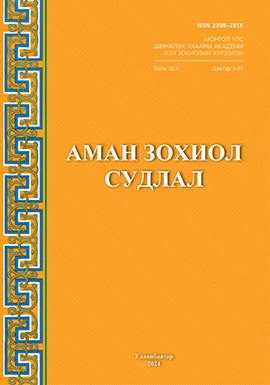
How to Cite
Ochir, T. (2024). Unveiling Tradition: Exploring the Information in Juunai’s Epic Jangar Manuscript. Studia Folclorica, 45(1), 18-29. https://doi.org/10.5564/sf.v45i1.4811