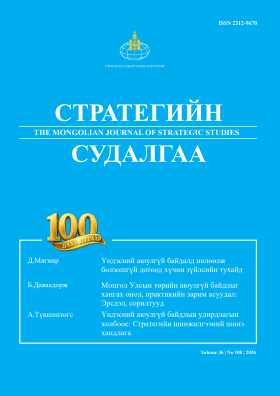
Theoretical and practical issues in ensuring state security of Mongolia: Risks and challenges
Keywords:
State security, statehood, national security, risk, challenges, geopolitics, MongoliaAbstract
This article examines the theoretical foundations of state security and its practical implementation, using Mongolia as a case study. The purpose of the research is to define, at a theoretical level, the interrelationship between the state, statehood, and state security, and to systematically assess the risks, challenges, and emerging trends facing Mongolia. The study employs both classical and contemporary theories in political and security studies, including realism, neorealism, securitization theory, and human security approaches. Methodologically, it applies comparative analysis alongside SWOT and PESTLE frameworks. The article aims to demonstrate that state security policy can be effectively implemented only through an integrated and continuous process that combines theoretical understanding, policy choices, institutional capacity, and internal stability. The findings indicate that the primary threats to Mongolia’s state security are not external military aggression, but rather internal disunity, political instability, and a system characterized by high external dependency. Therefore, state security policy should evolve toward a risk-based and preventive approach, with a focus on strengthening institutional capacity and deepening international cooperation.
Монгол Улсын төрийн аюулгүй байдлыг хангах онол, практикийн зарим асуудал: Эрсдэл, сорилтууд
Хураангуй: Энэхүү өгүүлэлд төрийн аюулгүй байдлын онолын суурь ойлголт, түүний практик хэрэгжилтийг Монгол Улсын жишээн дээр судлав. Судалгааны зорилго нь төр, төрт ёс, төрийн аюулгүй байдлын уялдаа холбоог онолын түвшинд тодорхойлж, Монгол Улсад тулгарч буй эрсдэл, сорилт, хандлагыг системтэй үнэлэхэд оршино. Судалгаанд улс төр, аюулгүй байдал судлалын сонгодог болон орчин үеийн реализм, неореализм, аюулгүйжүүлэлт, хүн-төвт аюулгүй байдал зэрэг онолыг үндэслэн харьцуулсан арга, SWOT болон PESTLE шинжилгээг ашиглав. Төрийн аюулгүй байдлын бодлого нь онолын ойлголт, бодлогын сонголт, институцийн чадавх, дотоод тогтвортой байдал гэсэн нэгдмэл, цогц үйл ажиллагаагаар тасралтгүй хэрэгжих боломжтой чухал үйл явц юм. Судалгааны үр дүнгээс үзэхэд Монгол Улсын төрийн аюулгүй байдалд тулгарч буй гол заналхийлэл нь гадаадын цэргийн халдлага бус харин дотоод эв нэгдэл, улс төрийн тогтворгүй байдал, гадаад улс орнуудаас хэт хамаарсан тогтолцоо болох нь тогтоогдож байна. Иймд аюулгүй байдлын бодлого нь эрсдэлд суурилсан, урьдчилан сэргийлэх, институцийн чадавхыг бэхжүүлэх, олон улсын хамтын ажиллагааг гүнзгийрүүлэх чиглэлд хөгжих шаардлагатай байна.
Түлхүүр үгс: Төрт ёс; үндэсний аюулгүй байдал; геополитик
96
Downloads
Published
Issue
Section
License
Copyright (c) 2026 Davaadorj Begz

This work is licensed under a Creative Commons Attribution 4.0 International License.

Articles in the Mongolian Journal of Strategic Studies are Open Access articles published under a Creative Commons Attribution 4.0 International License CC BY.
This license permits use, distribution and reproduction in any medium, provided the original work is properly cited.