Japan’s UN PKO Policy: An Empirical Study of Its Evolution on the Institutional Significance of the UN Triangular Partnership Programme (UNTPP)
Keywords:
United Nations Peacekeeping Operations (UN PKO), United Nations Triangular Partnership Programme (UNTPP), Middle Power Diplomacy, Japan’s PKO PolicyAbstract
This paper aims to empirically examine the evolution of Japan’s policy toward United Nations peacekeeping operations (hereafter “PKO”) by using the United Nations Triangular Partnership Programme (UNTPP) as an analytical lens. In the post–Cold War era, PKO mandates have shifted from traditional ceasefire monitoring toward “multidimensional” missions that include civilian protection, state-building, and humanitarian assistance. Alongside this shift, “capability gaps” regarding equipment, training, and specialized personnel have become increasingly evident in the field. Against the backdrop of these environmental changes and Japan’s domestic institutional constraints, Japan’s approach to contributing to PKO has also moved from a model centered on the deployment of contingents to one that emphasizes knowledge-driven contributions, such as training support and standard-setting. To empirically assess this process, the paper adopts a middle-power diplomacy perspective to illustrate the mechanism through which Japan exercises its capabilities and influences international frameworks by engaging in UN institutional design, and it offers implications for a contribution model by middle powers.
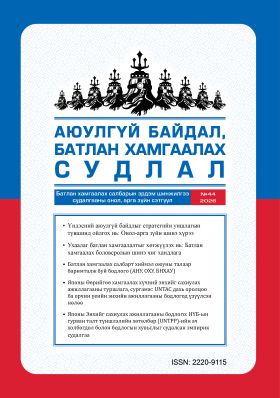
Японы Энхийг сахиулах ажиллагааны бодлого: НҮБ-ын гурван талт түншлэлийн хөтөлбөр (UNTPP)-ийн ач холбогдол болон бодлогын хувьслыг судалсан эмпирик судалгаа
Энэхүү өгүүлэл нь НҮБ-ын Гурван талт түншлэлийн хөтөлбөрт дүн шинжилгээ хийх замаар Япон Улсын НҮБ-ын энхийг сахиулах ажиллагаа (ЭСА)-ны бодлогын хувьсал, хөгжлийг эмпирик аргаар судлахыг зорьсон болно. Хүйтэн дайны дараах үед ЭСА-ны мандат нь уламжлалт гал зогсоох дэглэмийг хянах үйл ажиллагаанаас тэлж, энгийн номхон иргэдийг хамгаалах, төрийг цогцлоон байгуулах болон хүмүүнлэгийн тусламж үзүүлэх зэргийг багтаасан олон талт ажиллагаа руу шилжих болсон. Энэхүү өөрчлөлтийг дагаад ажиллагааны талбарт тоног төхөөрөмж, сургалт бэлтгэл, нарийн мэргэжлийн боловсон хүчний зэрэг “чадавхын дутагдал” улам бүр илт мэдрэгдэх болов. Эдгээр нөхцөл байдал болон Японы дотоод эрх зүйн орчны хязгаарлалтуудын улмаас тус улсын ЭСА-ны оролцооны чиг хандлагад өөрчлөлт гарснаар цэргийн бие бүрэлдэхүүн илгээх загвараас сургалтын дэмжлэг үзүүлэх, стандарт боловсруулах зэрэг мэдлэгт суурилсан загвар руу шилжсэн байна. Энэхүү өгүүлэлд Япон Улсын жишээн дээр тулгуурлан дунд гүрнүүд дипломат бодлого болон НҮБ-ын институцийн үйл ажиллагаанд оролцох замаар өөрсдийн олон улсын байр суурь, чадавхыг хэрхэн бэхжүүлж буйг судлан, олон улсын харилцаанд оруулж буй хувь нэмрийг шинжилсэн болно.
Түлхүүр үгс: НҮБ-ын энхийг сахиулах ажиллагаа (UN PKO), НҮБ-ын Гурвалсан түншлэлийн хөтөлбөр (UNTPP), дунд гүрний дипломат бодлого, Японы энхийг сахиулах ажиллагааны бодлого
47
References
1. Act for the Development of Peace and Security Legislation, Act No. 76 of 2015; International Peace Support Act, Act No. 77 of 2015.
2. Act on Cooperation with United Nations Peacekeeping Operations and Other Operations, Act No. 79 of 1992.
3. Cabinet Office of Japan, PKO Secretariat. (2025, June). Study group on the future of international peace cooperation: Summary of discussion. https://www.cao. go.jp/pko/pko_e/operations/pdf/202506_summary.pdf
4. Cooper, A. F., Higgott, R. A., & Nossal, K. R. (1993). Relocating middle powers: Australia and Canada in a changing world order. University of British Columbia Press. https://doi.org/10.59962/9780774853736
5. Honda, T. (2016). Kokuren no heiwa katsudō no shintenkan to enjiniaringu pīsu [New developments in UN peace activities and engineering peace]. Keio SFC Journal, 15(2), 98–119.
6. Hosokawa, Y. (2025). Kokuren heiwa iji katsudo kunren ni okeru sankaku patonashippu no keisei [The formation of triangular partnership in United Nations peacekeeping training] (Unpublished master’s thesis). National Defense Academy of Japan.
7. Ishida, T. (2026, March). Indo Taiheiyo ni oite tachiichi o mosaku suru Kankoku: Rizaimei gaiko no genjo to tenbo [South Korea seeking its position in the IndoPacific: Current status and prospects of Lee Jae-myung’s diplomacy]. NIDS Commentary, (421).
8. Japan Defense Agency. (1993). Defense of Japan (defense white paper) (Chapter 6). Author.
9. Ministry of Defense. (n.d.). Initiatives related to the UN PKO unit manual. https:// www.mod.go.jp/j/approach/kokusai_heiwa/pko/engn_manual.html
10. Ministry of Foreign Affairs of Japan. (n.d.-a). High-level meeting on UN peacekeeping: Overview and assessment. https://www.mofa.go.jp/mofaj/fp/ipc/ page18_000363.html
11. Ministry of Foreign Affairs of Japan. (n.d.-b). Prime Minister Abe’s attendance at the 2nd PKO Summit. https://www.mofa.go.jp/mofaj/fp/ipc/page3_001397.html
12. Ministry of Foreign Affairs of Japan. (n.d.-c). Japan’s cooperation for peace and reconstruction in Cambodia. https://www.mofa.go.jp/mofaj/area/cambodia/ kyoryoku.html
13. Ministry of Foreign Affairs of Japan. (2023). Japan’s international peace cooperation activities by the Self-Defense Forces under the International Peace Cooperation Act. Author. https://www.mofa.go.jp/fp/ipc/page22e_000683.html
14. United Nations. (1996). The blue helmets: A review of United Nations peacekeeping (3rd ed.). United Nations Department of Public Information. https:// digitallibrary.un.org/record/228891?v=pdf
15. United Nations. (2000, August 21). Report of the Panel on United Nations Peace Operations (Brahimi Report) (A/55/305–S/2000/809). https://undocs. org/A/55/305
16. United Nations. (2009, July). A new partnership agenda: Charting a new horizon for United Nations peacekeeping. https://peacekeeping.un.org/sites/default/files/ newhorizon_0.pdf
17. United Nations. (2010, May). Policy: Training for all United Nations peacekeeping personnel. United Nations. https://resourcehub01.blob.core. windows.net/training-files/Training%20Materials/002%20Policies/002-001%202010.20%20DPKO_DFS_POL_TrainingforallUNPKPersonnel_1May2010.pdf
18. United Nations. (2015, June 16). Report of the High-Level Independent Panel on Peace Operations: Uniting our strengths for peace—Politics, partnership and people (HIPPO Report) (A/70/95–S/2015/446). https://undocs.org/A/70/95
19. United Nations. (2017, December). Improving security of United Nations peacekeepers: We need to change the way we are doing business (Cruz Report). https://unpeacemission.org/sites/default/files/improving_security_of_united_ nations_peacekeepers_report.pdf
20. United Nations. (2018, September). Declaration of shared commitments on UN peacekeeping operations (Action for Peacekeeping) (paras. 7, 20). https:// peacekeeping.un.org/sites/default/files/a4p-declaration-en.pdf
21. United Nations. (2019, May). Current and emerging uniformed capability requirements for United Nations peacekeeping (p. 5). https://peacekeeping.un.org/ sites/default/files/uniformed-capability-requirements-un-peacekeeping_may2019.pdf
22. United Nations. (2021). Action for Peacekeeping Plus (A4P+): Priorities for 2021–2023. https://peacekeeping.un.org/sites/default/files/2026-02/a4p_ background_paper.pdf
23. United Nations Department of Peace Operations, Integrated Training Service. (2025). Core pre-deployment training materials (CPTM) 2025: Lesson 2.9, ‘Strategic communication and information integrity’. United Nations. https:// peacekeepingresourcehub.un.org/en/training/pre-deployment/cptm/intro
24. United Nations Department of Peacekeeping Operations. (2009). Standard operating procedure: Training recognition and certification. United Nations. https://resourcehub01.blob.core.windows.net/training-files/Training%20 Materials/002%20Policies/002-006%20Standard%20Operating%20 Procedure%20Training%20Recognition.pdf
25. United Nations Department of Peacekeeping Operations & Department of Field Support. (2008). United Nations peacekeeping operations: Principles and guidelines (Capstone Doctrine). United Nations. https://peacekeeping.un.org/sites/ default/files/capstone_eng_0.pdf
26. Williams, G. H. (2005). Engineering peace: The military role in postconflict reconstruction. United States Institute of Peace Press.
Downloads
Published
Issue
Section
License
Copyright (c) 2026 Takao Katsumata

This work is licensed under a Creative Commons Attribution 4.0 International License.
This license enables re-users to distribute, remix, adapt, and build upon the material in any medium or format, so long as attribution is given to the creator. The license allows for commercial use.