Lessons from the JSDF’s First PKO Deployment: Reconsidering Japan’s Participation in UNTAC and Its Implications for Contemporary Peacekeeping Policy
Keywords:
Japan Self-Defense Forces (JSDF), United Nations Transitional Authority in Cambodia (UNTAC), UN Peacekeeping Operations (PKO), International Peace Cooperation Law, Civilian Police, Germany–Japan ComparisonAbstract
This paper examines Japan’s participation in the United Nations Transitional Authority in Cambodia (UNTAC) in 1992 as the first deployment of the Japan Self-Defense Forces (JSDF) to a United Nations peacekeeping operation (PKO), and analyzes the institutional, operational, and policy lessons derived from this experience. Established under the International Peace Cooperation Law enacted in the post–Cold War international environment, Japan’s participation in UNTAC represented a critical starting point for the country’s international peace cooperation policy. This paper first examines the significance of the institutional framework based on the Five Principles for Participation in PKO. Second, it analyzes the development of overseas deployment capabilities and experience in multinational operations through airlift and sealift support by the Air Self-Defense Force and Maritime Self-Defense Force, as well as the activities of the engineering units deployed to Takeo Province. Third, it explores the impact of the death of a Japanese civilian police officer on domestic public opinion and governmental decision-making processes. In addition, by comparing Japan’s experience with that of Germany—another country that initiated overseas deployments under constitutional and historical constraints—this paper highlights the characteristics of peacekeeping participation by states with restricted military roles. Based on these analyses, the paper evaluates the significance of the UNTAC experience for subsequent improvements in Japan’s PKO framework and the development of JSDF international cooperation activities, and presents historical insights relevant to the future of United Nations peacekeeping operations.
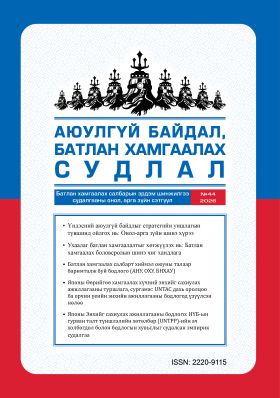
Японы Өөрийгөө хамгаалах хүчний энхийг сахиулах ажиллагааны туршлага, сургамж: UNTAC дахь оролцоо ба орчин үеийн энхийн ажиллагааны бодлогод үзүүлсэн нөлөө
Энэхүү өгүүлэлд Японы Өөрийгөө хамгаалах хүчин (ЯӨХХ)-ий НҮБ-ын энхийг сахиулах ажиллагаанд оролцсон анхны туршлага болох 1992 оны Камбож дахь UNTAC (United Nations Transitional Authority in Cambodia) ажиллагааг судлан авч үзэв. Хүйтэн дайны дараахан батлагдсан “Олон улсын энхийн хамтын ажиллагааны тухай хууль”-ийн хүрээнд хэрэгжсэн энэхүү ажиллагаа нь Япон Улсын энхийн төлөөх бодлогын чухал эхлэл цэг болсон юм. Өгүүллэгийн эхний хэсэгт Японы Энхийг сахиулах ажиллагааны таван зарчимт тогтолцоо, Агаарын болон Тэнгисийн Өөрийгөө хамгаалах хүчний үзүүлсэн агаар болон усан замын тээврийн дэмжлэг, мөн Такео мужид байрласан инженерийн цэргийн салбарын үйл ажиллагаа, тэр дундаа хилийн чанадад хүч байрлуулсан болон олон үндэстний ажиллагаанд оролцсон туршлага, Японы цагдаагийн алба хаагч амь эрсэдсэн эмгэнэлт хэрэг явдал, үүнтэй холбогдуулан олон нийтийн санаа бодол, төдийгүй Засгийн газрын шийдвэр гаргах үйл явцад дүн шинжилгээ хийв. Түүнчлэн Үндсэн хуулинд заагдсан “Зэвсэгт хүчин”-тэй байхыг хориглосон заалт болон түүхэн үйл явдлаас улбаатай хилийн чанадад цэрэг үл илгээх тухай эрх зүйн хязгаарлалт дор Герман, Япон хоёр улсын энхийг сахиулах ажиллагаанд оролцсон бодлого, хэрэгжилтийн онцлогийг харьцуулан судлав.
Түлхүүр үгс: Японы Өөрийгөө хамгаалах хүчин (ЯӨХХ), НҮБ-ын Камбож дахь шилжилтийн үеийн захиргаа (UNTAC); НҮБ-ын Энхийг сахиулах ажиллагаа (ЭСА), Олон улсын энхийн хамтын ажиллагааны тухай хууль, цагдаагийн амь нас, Герман-Японы улсын энхийг сахиулах ажиллагаа.
52
References
1. Boutros-Ghali, B. (1992). An agenda for peace: Preventive diplomacy, peacemaking and peace-keeping (A/47/277–S/24111). United Nations.
2. Cabinet Office, Government of Japan. (2001, December). Partial revision of the International Peace Cooperation Law. https://www.cao.go.jp/pko/pko_j/data/law/ law_data04.html.
3. Cabinet Office, Government of Japan. (n.d.). International peace cooperation operations in Cambodia (1992–1993). Retrieved April 15, 2026, from https://www. cao.go.jp/pko/pko_j/result/cambo/cambo02.html.
4. Fujishige, H. N. (2022). Cambodia: Japan’s first UNPKO contribution. In Japan’s peacekeeping at crossroads (pp. 85–102). Palgrave Macmillan. https://doi.org/10.1007/978-3-030-88509-0_5
5. Hatate, K. (2018). Confession: The truth behind the death of a PKO officer after 23 years.Kodansha. Institute for International Peace Research. (2013). Research on the future of international peace cooperation: Recommendations on the 20th anniversary of Japan’s participation in PKO. Institute for International Peace Research.
6. Japan Peacekeeping Training and Research Center, Joint Staff College (2023). Proceedings of the International Peace and Security Symposium 2022. Japan Peacekeeping Training and Research Center, Joint Staff College.
7. Kesavan, K. V. (2011). Japan’s role in the Cambodian peace settlement. Observer Research Foundation.
8. Kobashi, F. (2023). Factors behind the policy shift in out-of-area deployment of the Bundeswehr: Focusing on UNTAC deployment. Journal of Security Strategy Studies, 4(1), 59–82.
9. Ministry of Foreign Affairs of Japan. (n.d.). Japan’s contribution to UN peacekeeping operations (PKO). Retrieved April 15, 2026, from https://www.mofa.go.jp/fp/ipc/ page22e_000683.html.
10. Murakami, T. (2007). Cambodia PKO and Japan: Prototype of Japan’s “peace consolidation” policy. Military History Journal (Gunji Shigaku), 130–151.
11. National Institute for Defense Studies. (2010). Oral history of Tetsuya Nishimoto (Vol. 2). National Institute for Defense Studies.
12. Shin-yo, T. (2024). Oral history. National Graduate Institute for Policy Studies (GRIPS).
13. Shoji, T. (2015). Japan’s overseas deployment of the Self-Defense Forces and diplomacy. Yuhikaku.
14. Suzuki, K. (2017). Twenty-five years of Japanese peacekeeping operations and the Self-Defense Forces’ mission in South Sudan. Asia-Pacific Review, 24(2), 1–22. https://doi.org/10.1080/13439006.2017.1407534
15. Takeuchi, Y. (1994). A lonely decision. Gaiko Forum, 7(1), 95-96.
16. Watanabe, T. (2007). Pride in the field: Reflections of a UNTAC engineering unit commander. Gunji Shigaku, 152–166.
17. Yamashita, H. (2022). Germany and peacekeeping operations. NIDS Security Studies, 13(1), 3–29.
Downloads
Published
Issue
Section
License
Copyright (c) 2026 Ryuji HOMMYO

This work is licensed under a Creative Commons Attribution 4.0 International License.
This license enables re-users to distribute, remix, adapt, and build upon the material in any medium or format, so long as attribution is given to the creator. The license allows for commercial use.