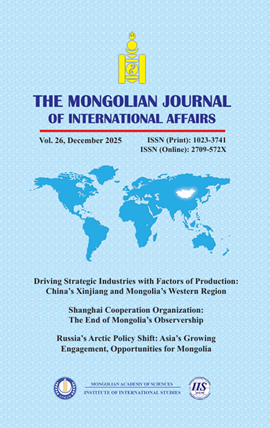
Shanghai Cooperation Organization: The End of Mongolia’s Observership
Keywords:
Shanghai Cooperation Organization, Geopolitics, Foreign Policy, Central and East Asia, Regional OrganizationAbstract
The Shanghai Cooperation Organization (SCO) has evolved as a regionally important and internationally attractive regional organization. Albeit its inherent challenges of dealing with competitive interests of great powers, regional powers, and Central Asia states, the SCO has become well institutionalized as an organization, endured during the global pandemics and geopolitical tensions, and kept its focus on Central Asia. Mongolia had been welcomed by its two powerful members, China and Russia, to become a full member of the organization, but this invitation was not uniformly endorsed by Mongolian political leaders, pundits, and even the public. This resulted in an observer status. However, last September, the SCO merged both observer and partner statuses - ending Mongolia’s unique status of the observer. This article argues a key reason for Mongolia’s hesitance in joining the SCO is its explicit regional identification with East Asia, not Central Asia. We will discuss Mongolia's involvement during different phases of the organizational evolution, analyze the internal debate about the country’s membership, and present our explanation of contemporary Mongolia’s identification with the East Asian region.
1591
References
Autin, A. (2024). “Putin’s Red Carpet in Mongolia Was a Betrayal of Justice and Accountability”., published in the “The Kyiv Independent”, Available at https://kyivindependent.com/opinion-putins-red-carpet-in-mongolia-was-a-betrayal-of-justice-and-accountability/, September 16, 2024
Bolor, J. (2019). B.Battsetseg: Mongolia’s SCO membership has not been officially discussed .Interview with the Vice Foreign Minister, in MONTSAME, 22 Feb. 2019. Available at https://montsame.mn/en/read/180998.
China–Mongolia–Russia Trilateral Summit. (2016). Tashkent Agreement on the CMR Economic Corridor (China–Mongolia–Russia Trilateral Summit, 2016). 2016, June 23
Collectivity Security Treaty Organization. (CSTO). (2025). Accessed in 29.09.2025, “Contingents of the CSTO Collective Peacekeeping Forces are deployed to the Republic of Kazakhstan”, 06.01.2022, Available at https://en.odkb-csto.org/news/news_odkb/kontingenty-kollektivnykh-mirotvorcheskikh-sil-odkb-napravleny-v-respubliku-kazakhstan/#loaded,
Consilium Libratum. (2021). “SCO 20 Years”. 2021.
Council of Heads of State of the SCO. (2025). Tianjin Declaration (Council of Heads of State of the Shanghai Cooperation Organization, 2025). 2025, September 1
Dorjjugder. M, Nyamjav, S. (2021). The Development and Perspectives of the Shanghai Cooperation Organization and Participation of Mongolia. SCO Blue Book (2021) Twenty Years of the SCO: Achievements and Experiences, Available at http://eng.sectsco.org/cooperation/.
Encyclopaedia Britannica. (2025). Shanghai Cooperation Organization. In Britannica. https://www.britannica.com/topic/Shanghai-Cooperation-Organization
Ministry of External Affairs of India. (2020). Brief of India Mongolia Bilateral Relations, Jan. 2020. Available at https://mea.gov.in/Portal/ForeignRelation/India_Mongolia_2020.pdf. Accessed in 29.09.2025
Ministry of Foreign Affairs Peoples of Republic of China. (Ministry of Foreign Affairs PRC). (2014). Xi Jinping Holds Talks with President Tsakhiagiin Elbegdorj of Mongolia and the Two Heads of State Unanimously Agree to Upgrade Bilateral Relations to Comprehensive Strategic Partnership”., Available at https://www.mfa.gov.cn/eng/wjb/zzjg_663340/xws_665282/xgxw_665284/202406/t20240606_11405660.html
National Security Council of Mongolia. (2015). Press release, 9 Sep. 2015. Available at https://nsc.gov.mn/?q=node/323.
President of Mongolia. (2018). “President addresses 18th meeting of SCO council of heads of member states”, Press release, 10 June 2018. Available at https://president.mn/en/2018/06/10/president-addresses-meeting-of-sco-council-of-heads-of-state/.
President of Mongolia. (2019). Mongolian President Kh.Battulga delivers speech at SCO expanded meeting Press release, 14 June 2019. Available at https://president.mn/9379/.
President of Mongolia. (2020). Speech to the meeting of the Council of Heads of State of SCO member States, 10 Nov. 2020. Available at https://president.mn/en/2020/11/10/speech-to-the-meeting-of-the-council-of-heads-of-state-of-sco-member-states/.
SCO Secretariat, Shanghai Declaration on the establishment of the SCO. (2001). Available at http://eng.sectsco.org/documents/; Shanghai Cooperation Organization. (2001). Charter of the Shanghai Cooperation Organization. http://eng.sectsco.org/documents/
Shanghai Cooperation Organization. (SCO). (2005). The Declaration of Heads of Member States of the Shanghai Cooperation Organization on 5 July 2005 stated: “Considering the completion of the active military stage of antiterrorist operation in Afghanistan, the member states of the Shanghai Cooperation Organization consider it necessary, that respective members of the antiterrorist coalition set a final timeline for their temporary use of the above-mentioned objects of infrastructure and stay of their military contingents on the territories of the SCO member states” (16 June 2017). Available at www.sectsco.org.
Shanghai Cooperation Organization. (SCO). (2025). SCO Development Strategy for the Next 10 Years (Shanghai Cooperation Organization, 2025) (2026–2035). Tianjin.
State Council of Information Office the Peoples of China. (2023). China developing SCO demonstration area into new Belt and Road cooperation platform. Xinhua, October 12, 2023, Available at http://english.scio.gov.cn/beltandroad/2023-10/12/content_116739366.htm, Accessed in 29.09.2025
Treaty on Deepening Military Trust in Border Regions. (1996). Treaty on Deepening Military Trust in Border Regions, 1996. (1996, April 26). Signed in Shanghai.
Downloads
Published
Issue
Section
License
Copyright (c) 2025 Soyolgerel Nyamjav, Mendee Jargalsaikhan

This work is licensed under a Creative Commons Attribution 4.0 International License.
Copyright on any research article in the Mongolian Journal of International Affairs is retained by the author(s).
The authors grant the Mongolian Journal of International Affairs a license to publish the article and identify itself as the original publisher.

Articles in the Mongolian Journal of International Affairs are Open Access articles published under a Creative Commons Attribution 4.0 International License CC BY.
This license permits use, distribution and reproduction in any medium, provided the original work is properly cited.